
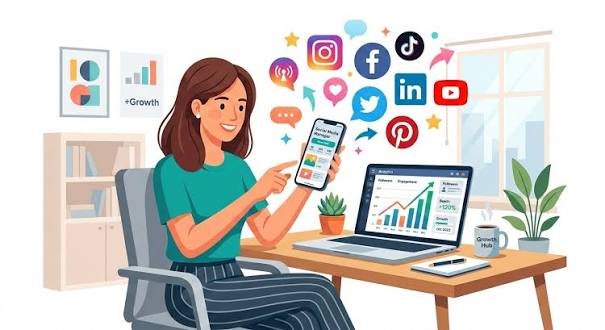
Small Businesses Can Use Digital Marketing to Grow in today’s competitive business environment, small businesses face many challenges. They often compete with larger companies that have bigger budgets, more employees, stronger brand recognition, and greater resources. However, the growth of digital technology has changed the way businesses reach customers. Today, a small business can use digital marketing to reach thousands of potential customers without spending huge amounts of money on traditional advertising.
Digital marketing has become one of the most powerful tools for small businesses. Whether you run a local shop, restaurant, beauty business, freelance service, startup, online store, or professional service, digital marketing can help you increase visibility, attract customers, build relationships, and generate sales.
But digital marketing is not simply about posting pictures on social media. It involves understanding your target audience, creating valuable content, optimizing your online presence, using paid advertising strategically, and measuring your results.
This article explains how small businesses can use digital marketing effectively to grow their business and build a strong online presence.
What Is Digital Marketing?
Digital marketing is the process of promoting a business, product, or service through digital channels. Instead of depending only on traditional advertising methods such as newspapers, television, radio, brochures, and billboards, businesses can use online platforms to connect with potential customers.
Some important digital marketing channels include:
- Search Engine Optimization (SEO)
- Social Media Marketing
- Content Marketing
- Google Ads
- Meta Ads
- Email Marketing
- Video Marketing
- Influencer Marketing
- Website Marketing
- Online Reputation Management
The biggest advantage of digital marketing is that businesses can reach specific audiences and measure the performance of their campaigns.
For a small business, this can make marketing more affordable, targeted, and measurable.
Why Digital Marketing Matters for Small Businesses
Large companies may have millions of dollars available for advertising, but small businesses usually need to be more careful with their budgets.
Digital marketing provides opportunities to compete based on creativity, relevance, customer relationships, and value rather than budget alone.
For example, a local bakery can use Instagram to showcase its cakes, Google Business Profile to help customers find its location, and WhatsApp or email to communicate with customers.
A freelance graphic designer can use LinkedIn and Instagram to showcase a portfolio and attract clients.
A small clothing store can use Instagram Reels, Meta Ads, and an e-commerce website to reach customers beyond its local area.
This demonstrates an important point:
Small businesses do not need to be everywhere online. They need to be where their customers are.
1. Create a Professional Website
A website is one of the most important foundations of digital marketing.
Your social media profiles may attract attention, but your website can provide customers with complete information about your business.
A professional website should clearly communicate:
- What your business offers
- Who you serve
- Your products or services
- Pricing or packages where appropriate
- Contact information
- Customer testimonials
- Business location
- Frequently asked questions
- Clear calls to action
For example, a digital marketing freelancer could have separate pages for SEO, social media marketing, Google Ads management, and content marketing.
The website should also be mobile-friendly because many customers access websites through smartphones.
A website should not simply look attractive. It should help visitors take action.
Examples of calls to action include:
Contact Us
Book a Consultation
Request a Quote
Shop Now
Learn More
A well-designed website can turn online visitors into leads and customers.
2. Use SEO to Get Found on Google
Search Engine Optimization, or SEO, is another powerful strategy for small businesses.
SEO involves improving your website and online presence so that search engines can better understand and display your business for relevant searches.
Imagine someone searches:
“Best bakery near me.”
If your bakery has a strong local SEO presence, your business may have a better chance of appearing in relevant search results.
Small businesses can focus on:
- Keyword research
- On-page SEO
- Local SEO
- Technical SEO
- Content creation
- Internal linking
- Website speed
- Mobile optimization
- Online reviews
Local SEO is especially valuable for businesses serving specific geographic areas.
For example:
“Digital marketing agency in Kerala”
“Best salon in Kondotty”
“Wedding photographer in Malappuram”
By creating useful content around relevant search topics and maintaining accurate business information online, small businesses can attract people who are actively looking for their products or services.
3. Build a Strong Social Media Presence
Social media is one of the easiest ways for small businesses to connect directly with customers.
Platforms such as Instagram, Facebook, LinkedIn, and YouTube provide opportunities to showcase products, educate audiences, answer questions, and build communities.
However, businesses should avoid treating social media as a simple advertising board.
Instead of constantly saying:
“Buy our product!”
businesses can create content that provides value.
For example, a skincare business could post:
- Skincare tips
- Product demonstrations
- Customer reviews
- Frequently asked questions
- Before-and-after content
- Educational videos
- Behind-the-scenes content
A restaurant could share:
- Food preparation videos
- New dishes
- Customer experiences
- Special offers
- Staff stories
- Short cooking videos
Valuable and entertaining content can help businesses build trust before asking customers to make a purchase.
4. Use Content Marketing to Build Trust
Content marketing involves creating and sharing useful information that attracts and helps your target audience.
Content can include:
- Blog articles
- Videos
- Instagram posts
- Reels
- Infographics
- Guides
- Case studies
- Podcasts
- Newsletters
For example, a fitness business could create content about healthy habits, workout tips, and beginner exercises.
A digital marketing consultant could publish articles about SEO, Google Ads, social media marketing, and content strategy.
Content marketing helps businesses demonstrate expertise.
Instead of simply telling customers:
“We are experts.”
you can demonstrate your knowledge through valuable content.
Over time, this can improve credibility and encourage potential customers to choose your business.
5. Use Google Ads to Reach High-Intent Customers
Organic marketing can take time. Paid advertising can help small businesses reach potential customers more quickly.
Google Ads can be particularly useful when people are actively searching for products or services.
For example:
“SEO services near me”
“Buy women’s shoes online”
“Best wedding photographer”
“Digital marketing course near me”
These searches can indicate strong customer intent.
Small businesses can create targeted campaigns based on relevant keywords, locations, audiences, and business objectives.
However, paid advertising should not simply focus on getting clicks.
The real goal should be generating meaningful results such as:
- Leads
- Sales
- Bookings
- Phone calls
- Enquiries
Businesses should track conversions and optimize campaigns based on performance.
6. Use Meta Ads for Awareness and Customer Acquisition
Meta Ads allow businesses to advertise across platforms such as Facebook and Instagram.
They can be especially useful for businesses with visually appealing products or services.
For example, a clothing business can showcase its products through:
- Reels
- Stories
- Carousel Ads
- Product images
- Short videos
Meta Ads can also help businesses reach specific audience segments and reconnect with people who have previously interacted with the business.
A customer may visit a website without purchasing. Retargeting can help remind that customer about the product or offer later.
This makes Meta Ads useful for both customer acquisition and remarketing.
7. Take Advantage of Local Marketing
For small businesses that operate in a specific area, local digital marketing can be extremely important.
A business should make sure that its online information is accurate and consistent.
Important information includes:
- Business name
- Address
- Phone number
- Opening hours
- Website
- Photos
- Customer reviews
A strong Google Business Profile can help local customers discover a business when searching for relevant products or services.
For example, someone searching for:
“coffee shop near me”
may see local businesses in search results and on Google Maps.
Customer reviews are also important because people often use reviews when deciding which local business to trust.
Encourage satisfied customers to leave honest reviews and respond professionally to feedback.
8. Use Email Marketing to Build Customer Relationships
Email marketing remains a valuable strategy for small businesses because it allows businesses to communicate directly with people who have already shown interest.
Businesses can use email to send:
- Newsletters
- Product updates
- Special offers
- Educational content
- Event announcements
- Personalized recommendations
- Follow-up messages
For example, an online clothing store could send an email about a new collection to previous customers.
An educational business could send useful learning resources to its subscribers.
The key is to avoid sending unnecessary promotional emails too frequently.
Good email marketing should provide value while also encouraging customers to take appropriate action.
9. Use Video Marketing
Video has become an important part of digital marketing.
Small businesses can create simple videos using smartphones without requiring expensive equipment.
Video ideas include:
- Product demonstrations
- Tutorials
- Customer testimonials
- Behind-the-scenes videos
- Frequently asked questions
- Educational content
- Company introductions
- Short-form videos
Instagram Reels, YouTube Shorts, and other short-form video platforms can help businesses reach new audiences.
A small business does not need a professional studio to create useful content.
Good lighting, clear audio, valuable information, and an engaging message can be more important than expensive equipment.
10. Work With Micro-Influencers
Influencer marketing does not always require working with celebrities.
Small businesses can consider collaborating with micro-influencers who have smaller but highly engaged audiences.
For example, a local fashion store could collaborate with a local fashion creator.
A restaurant could work with a local food content creator.
A beauty brand could collaborate with a niche beauty creator.
The most important factor is not simply follower count.
Businesses should consider:
- Audience relevance
- Engagement
- Content quality
- Trust
- Location
- Brand compatibility
A smaller, highly relevant audience can sometimes be more valuable than a large but unrelated audience.
11. Create a Strong Brand Identity
Digital marketing is not only about advertising. It is also about building a recognizable brand.
Small businesses should maintain consistency across their digital platforms.
This includes:
- Logo
- Colors
- Fonts
- Photography style
- Tone of voice
- Messaging
- Brand values
When customers repeatedly see consistent branding, it becomes easier for them to recognize the business.
A strong brand can help a small business appear more professional and memorable.
12. Use Customer Reviews and Testimonials
People often trust other customers more than advertisements.
Testimonials and reviews can therefore become powerful marketing tools.
Businesses can showcase genuine customer feedback on:
- Websites
- Social media
- Google Business Profile
- Product pages
- Advertisements
For example, instead of simply saying:
“Our service is excellent.”
a business can show real customer experiences.
Testimonials can reduce uncertainty and help potential customers feel more confident about purchasing.
Businesses should always use authentic reviews rather than creating fake testimonials.
13. Use Analytics to Measure Results
One of the greatest advantages of digital marketing is the ability to measure performance.
Businesses can track metrics such as:
- Website visitors
- Traffic sources
- Engagement
- Leads
- Sales
- Conversion rate
- Cost per lead
- Customer acquisition cost
- Return on advertising spend
These insights help businesses understand what is working and what needs improvement.
For example, if Instagram generates many views but very few enquiries, the business may need to improve its call to action or targeting.
If Google Ads generates leads at a profitable cost, the business may consider increasing its investment.
What gets measured can be improved.
14. Start Small and Scale Gradually
One of the biggest mistakes small businesses make is trying to do everything at once.
You do not need:
- Five social media platforms
- Daily blog posts
- Huge advertising budgets
- Expensive video equipment
- Dozens of campaigns
Instead, start with a focused strategy.
For example:
Month 1
Build your website and social media profiles.
Month 2
Start creating useful content and optimize your local SEO.
Month 3
Test a small paid advertising campaign.
Month 4
Analyze results and improve your strategy.
Month 5
Scale the channels that produce the best results.
This approach allows businesses to learn without wasting resources.
15. Focus on the Customer Journey
Successful digital marketing should guide customers through different stages.
Awareness
The customer discovers your brand.
Tools: Social media, video, content, advertising.
Interest
The customer wants to learn more.
Tools: Website, blogs, product pages, educational content.
Consideration
The customer compares your business with alternatives.
Tools: Reviews, testimonials, case studies, FAQs.
Conversion
The customer takes action.
Tools: Offers, landing pages, calls to action, easy checkout or enquiry forms.
Retention
The customer returns.
Tools: Email marketing, social media, loyalty programs, excellent customer service.
Digital marketing becomes more effective when businesses understand this entire journey rather than focusing only on the first sale.
Common Digital Marketing Mistakes Small Businesses Should Avoid
Small businesses should also be aware of common mistakes.
1. Trying to Reach Everyone
A clearly defined target audience is more valuable than a huge but irrelevant audience.
2. Posting Without a Strategy
Random content may generate activity without generating business results.
3. Ignoring SEO
A beautiful website is less useful if potential customers cannot find it.
4. Focusing Only on Followers
Followers are useful, but leads, sales, and customer relationships matter more.
5. Ignoring Customer Reviews
Reviews can significantly influence purchasing decisions.
6. Spending on Ads Without Tracking
Advertising without conversion tracking can result in wasted money.
7. Giving Up Too Quickly
Digital marketing requires testing, learning, and continuous improvement.
A Simple Digital Marketing Strategy for Small Businesses
A small business can follow this simple framework:
Step 1: Identify your target audience.
Understand who your ideal customers are, what they need, and what problems they want to solve.
Step 2: Build your online foundation.
Create a professional website and optimize your business profiles.
Step 3: Choose the right platforms.
Focus on the channels where your customers are most active.
Step 4: Create valuable content.
Educate, entertain, inspire, and solve customer problems.
Step 5: Use paid advertising strategically.
Start with a manageable budget and test different campaigns.
Step 6: Track performance.
Measure leads, sales, conversions, and return on investment.
Step 7: Optimize and scale.
Invest more in strategies that consistently produce positive results.
Conclusion
Digital marketing has created a powerful opportunity for small businesses to compete, grow, and build strong relationships with customers.
A small business does not need a massive marketing budget to succeed online. What it needs is a clear strategy, a strong understanding of its target audience, consistent communication, valuable content, and a willingness to measure and improve its results.
From SEO and social media marketing to Google Ads, Meta Ads, content marketing, email marketing, and video marketing, there are many tools available.
However, success does not come from using every digital marketing channel at once. It comes from choosing the right channels and using them effectively.
The most successful small businesses understand that digital marketing is a long-term investment. They build trust before asking for a sale, provide value instead of constantly promoting products, listen to customer feedback, and use data to make better decisions.
Whether you are running a local store, startup, online business, restaurant, freelance service, or professional brand, digital marketing can help you reach more people and turn online attention into real business growth.
Start small. Stay consistent. Measure your results. Learn from your audience. Improve your strategy. Then scale what works.